
June 2026
Use Sun Tzu’s "Miao Suan" to Calculate Your Restaurant’s Survival Line [2026]
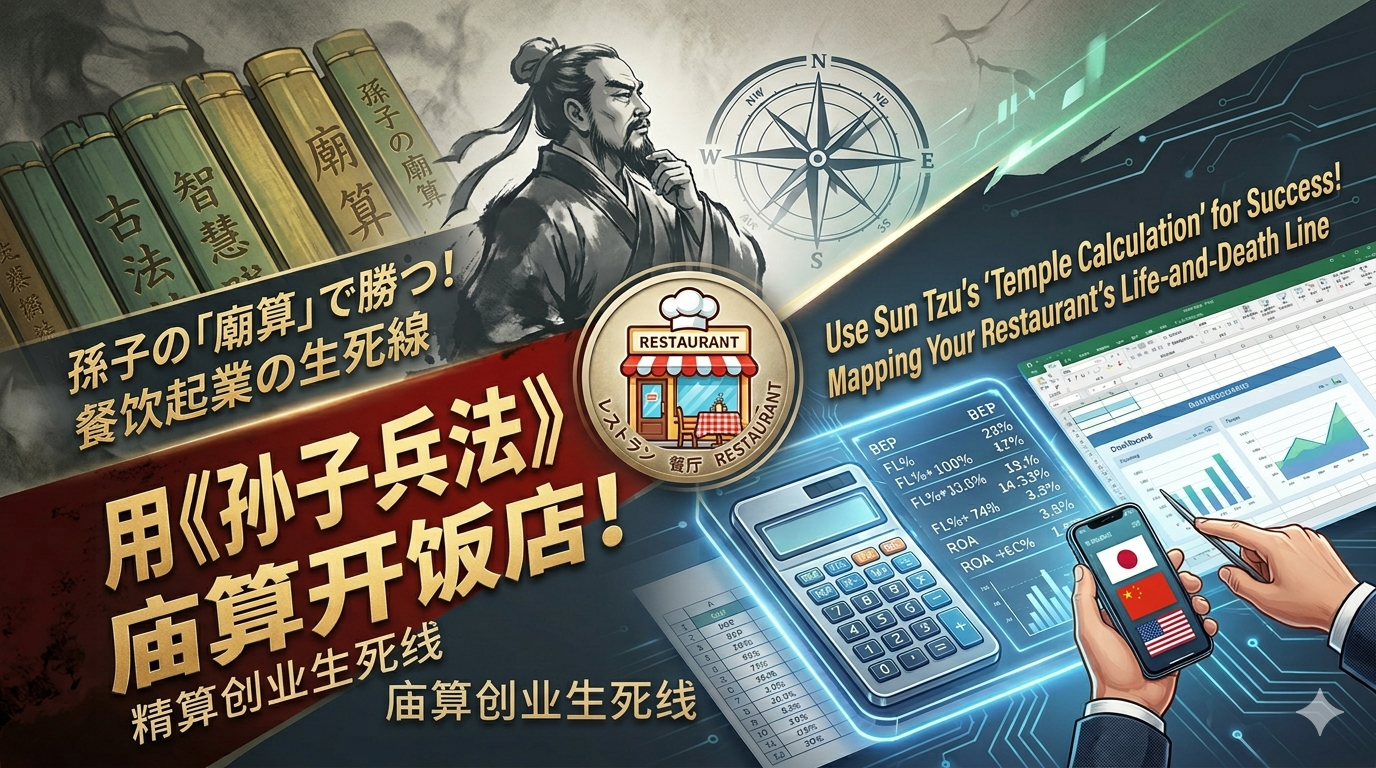
There is a brutal statistic in the restaurant industry: 30% of new restaurants close within one year, and 70% close within three years.
Many people start a restaurant based on "passion" and "love for food." But from the perspective of Sun Tzu's Art of War, this is no different from rushing into battle without preparation.
Sun Tzu wrote in the chapter "Initial Estimations":
"Now the general who wins a battle makes many calculations in his temple before the battle is fought. The general who loses a battle makes but few calculations beforehand. Thus do many calculations lead to victory, and few calculations to defeat."
Starting a business is not gambling. Before opening, you must calculate every variable on paper. If you cannot win on paper before opening, you will inevitably be among the 70% who fail.
In this article, we use the case of "an experienced hotel chef opening their own restaurant" to walk through the complete pre-startup calculation process using Sun Tzu's "Five Matters, Seven Calculations" model.
Step 1: Use the "Five Matters" Model to Analyze Your Restaurant's Survival Dimensions
Sun Tzu proposed five immutable dimensions (the Five Matters) for evaluating victory or defeat in battle: Dao, Tian, Di, Jiang, Fa.
1. Dao (Vision & Customer Resonance) — Why Would Customers Choose You?
Classic: "The Dao causes the people to be in complete accord with their ruler."
Can your core product create strong resonance with customers? A hotel chef may have excellent skills, but bringing complex haute cuisine to a small street-side shop with high prices will create a mismatch between you and your customers — a failure of "Dao."
Decision: Find a single item with high addictiveness and repeat purchase (e.g., regional handmade noodles, signature sauce meat). Use hotel-level technique to deliver mass-market essentials — that is the true "Dao."
2. Tian (Timing & Trends) — Tailwind or Headwind?
Classic: "Heaven encompasses yin and yang, cold and heat, and the constraints of the seasons."
Assess the macroeconomic environment and industry cycle. Today's restaurant industry faces two major headwinds: soaring ingredient costs and labor shortages (rising wages).
Decision: Avoid traditional full-service restaurants that require large teams. Choose digitally-enabled, minimal-labor dining concepts that align with the "anti-inflation, high-efficiency" trend.
3. Di (Location & Terrain) — Rent Determines Life or Death
Classic: "Earth encompasses distances, danger and security, open ground and narrow passes, and the chances of life and death."
Ground-floor street-front shops are "living ground" — high foot traffic but exorbitant rent and deposits. Second-floor or alley locations are "dangerous ground" — lower rent but heavily dependent on social media and word-of-mouth traffic.
Decision: A chef with skill can rely on "good wine needing no bush." Avoid expensive rent. Choose a second-floor or community shop, keeping rent firmly below 10% of projected revenue.
4. Jiang (Team & Personal Capability) — From Craftsman to Business Owner
Classic: "The commander encompasses wisdom, trustworthiness, benevolence, courage, and strictness."
Evaluate your personal capability profile. In a hotel kitchen, you were responsible only for the "palate." Now as an owner, can you be responsible for the "ledger"? Can you endure 12-hour days of intense physical labor?
Decision: The founder must complete a mental transformation — a master chef in the kitchen, a miser over the ledger.
5. Fa (Financial Model & Systems) — The Mathematical Line of Invincibility
Classic: "Method encompasses military organization, chain of command, and logistics."
This is where precise mathematical calculation is essential. We introduce the restaurant industry's most hardcore FL cost rule (Food cost + Labor cost).
Step 2: Hardcore Math — The "Fa" of Your Restaurant
Sun Tzu said: "In war, victory is valued, not prolonged operations." Whether a restaurant survives depends entirely on its break-even point (BEP).
Let's build a financial model for a chef opening a 15-tsubo (~50 sqm, 25-seat) small restaurant.
| Category | Ideal % | Monthly Budget | Art of War Analysis |
|---|---|---|---|
| R (Rent) | 10% | 300,000 JPY | Back-calculate monthly revenue target of 3M JPY |
| F (Food cost) | 30% | 900,000 JPY | Use supply chain & standardisation to eliminate waste |
| L (Labor) | 30% | 900,000 JPY | Life-or-death! Chef + 1 part-timer, keep minimal |
| Other (utilities/tax) | 15% | 450,000 JPY | Fixed expenses, hard to reduce |
| Net Profit (owner) | 15% | 450,000 JPY | Realistic return for business risk |
Reverse Calculation: How Many Meals Per Day?
To achieve 3M JPY monthly revenue, assuming 26 operating days per month:
Daily revenue target: 3M ÷ 26 = approx. 115,000 JPY/day
At 1,000 JPY lunch: 115 customers/day needed. 25 seats require 4.6 turns at lunch — tactically extremely difficult (almost "dead ground").
At 4,000 JPY evening course/izakaya: Only 29 customers/day needed. 1.2 turns — difficulty drops dramatically, odds of success soar!
Step 3: Final Decision — Many Calculations Lead to Victory
After completing the above calculations, run different business ideas through this "decision funnel."
[Idea Pool: Large banquet restaurant vs. High-value single-item specialty shop]
↓
[FL Cost Verification (reject if labor or rent is too high!)]
↓
[Standardization Check (can a part-timer serve in 2 minutes without the chef? If not, reject!)]
↓
[Final Decision: Victory Secured Before Battle]
The Chef's Ultimate Survival Strategy: First Make Yourself Invincible
Sun Tzu's final advice is not "go big," but the following three principles.
Find "move-in ready" properties (居抜き):
Never start from bare-shell construction. Find a property with existing interior fit-out, keep initial investment minimal, and maintain 6 months of fixed expenses as operating runway.
Pre-process, one-person operation:
Before opening, centralize complex hotel recipes into standardized sauce packets and broths. A 1-2 person team can run the entire operation, minimizing labor costs.
Sun Tzu said: "First be invincible, then wait for the enemy to become vulnerable." Before starting your business, compress fixed costs and labor to a level no competitor can break. The rest is waiting for your market opportunity.
Consult Kaisei for business strategy, market analysis, and business planning
Our experts support hospitality, investment, and Japan market entry.
Free Consultation