
June 2026
Is the Minpaku Business Over in Tokyo? Navigating 2026 Regulations

"Minpaku in Tokyo is no longer profitable"
Recently, we've been hearing this more often. Tokyo's 23 wards have been progressively tightening their own minpaku ordinances, restricting operating days and regulating owner-absent minpaku. 2026 has been a turning point, with even previously relaxed areas introducing new restrictions.
So, is the Tokyo minpaku market really over?
The answer: **The era of "easy money minpaku" is over, but for properly operated businesses, opportunities are actually increasing.**
Why are minpaku regulations tightening?
Three major factors are driving this change.
1. Overtourism from inbound recovery
Post-COVID, inbound tourism rebounded rapidly, bringing issues like trash rule violations, late-night noise, suitcase congestion on residential streets, and unknown visitors in condominiums. Resident complaints have surged.
2. Stronger administrative enforcement
Previously, a simple notification was enough. Now, authorities actively crack down on illegal operations, conduct on-site inspections, issue business suspension orders, and respond quickly to resident reports.
3. Balancing with the hotel industry
Hotels and ryokan meet strict fire safety and guest management standards. The perceived unfairness of looser minpaku regulations has pushed authorities to create a more level playing field.
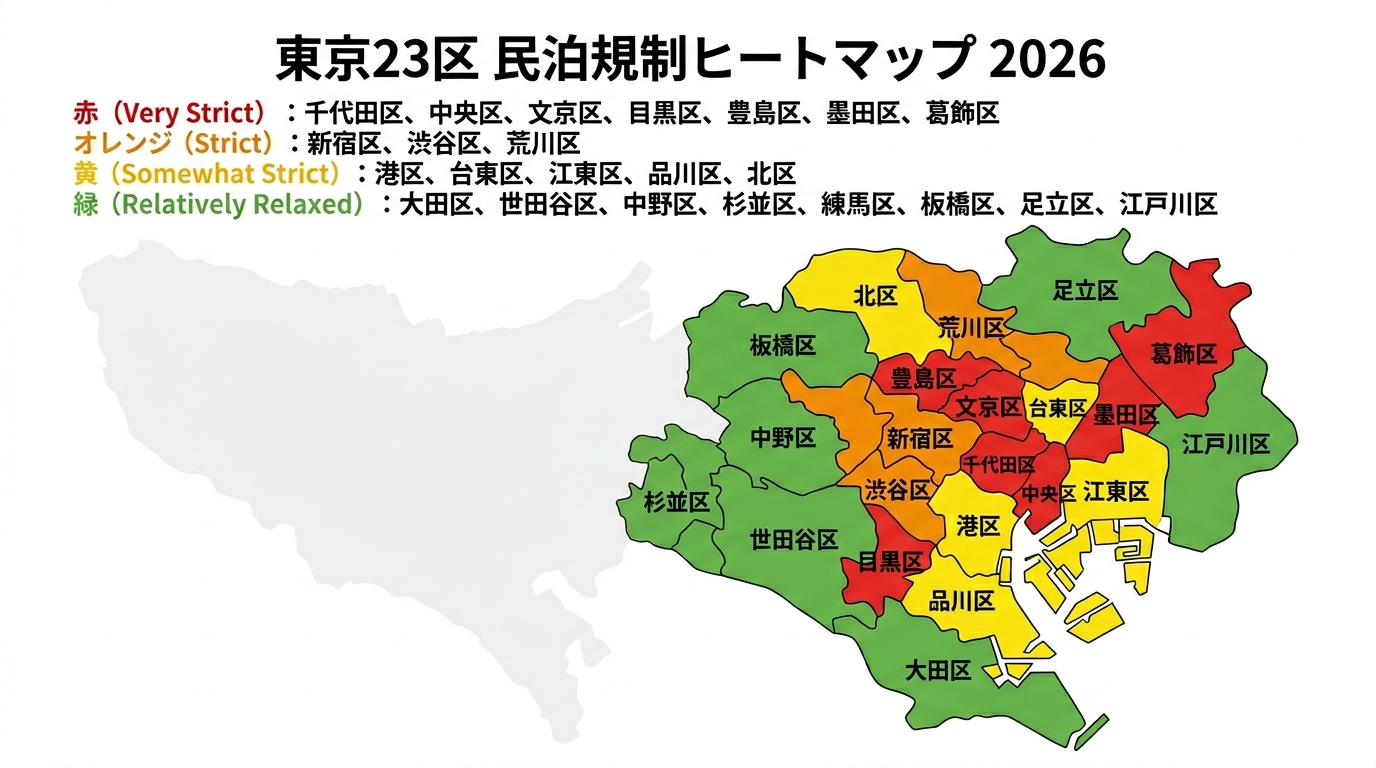
Tokyo 23 Wards Minpaku Regulation Map (2026)
The severity of regulations varies greatly by ward. Below is a 4-tier classification.
Very Strict
Strict
Moderate
Relatively Lenient
A-Rank (Very Strict)
Arakawa, Chuo, Chiyoda, Meguro, Bunkyo, Toshima, Sumida, Katsushika
Ordinances such as weekend-only operations or 120-day limits significantly impact business profitability.
B-Rank (Strict)
Shinjuku, Shibuya
Restrictions include weekday operation bans in exclusive residential zones.
C-Rank (Moderate)
Minato, Taito, Koto, Shinagawa, Kita
While area-based restrictions exist, commercial zones are relatively easier to operate in many cases.
D-Rank (Relatively Lenient)
Ota, Setagaya, Nerima, Itabashi, Adachi, Edogawa, Nakano, Suginami
These wards are relatively unaffected beyond the 180-day limit under the Private Lodging Business Act.
3 reasons people say "minpaku is over"
Reason 1: The 180-day cap makes profitability difficult
The Private Lodging Business Act limits operations to 180 days per year. Ward ordinances may further restrict this. High-rent or mortgaged properties struggle to turn a profit.
Reason 2: Rising operational costs
Labor, utilities, cleaning, amenities, and management fees have all risen. The old "set-and-forget" model no longer works.
Reason 3: Intensified price competition with hotels
Travelers increasingly find hotels more convenient. Check-in ease, security, and service quality favor hotels, especially for international visitors.
Why minpaku isn't actually over
This is the most important insight.
The market is being cleaned up
Regulation is pushing out illegal and low-quality operators. For compliant businesses, this means less competition.
Inbound demand remains strong
Japan is a globally popular destination. Tokyo, Osaka, Kyoto, and Hokkaido continue to see strong accommodation demand. Family and group travelers often prefer minpaku over hotels.
Differentiated minpaku are valued
Design, location, reviews, and inbound readiness matter. "Chosen" accommodations, not just "places to sleep," are thriving.
Strategies for surviving minpaku operators
1. Obtain a hotel license
365-day operation capability dramatically improves profitability.
2. Prioritize community relations
Strict waste management and noise control prevent neighborhood conflicts.
3. Adopt a differentiation strategy
Compete on design, cleanliness, and hospitality rather than price.
4. Diversify across regions
Expand from Tokyo-centric operations to regional tourist destinations, resort areas, and hot spring towns.
Conclusion: Is Tokyo minpaku over?
The answer is NO.
Yes, casual side-business minpaku, illegal operations, and ill-prepared profit-driven minpaku are being weeded out. But for operators who obtain proper licenses, differentiate their services, cooperate with local communities, and meet inbound demand — the opportunities are expanding.
The Tokyo minpaku market hasn't "ended." It has **evolved from a market anyone could enter into one where professionals are chosen.**
Consult Kaisei for accommodation startup, operations, and regulatory compliance
Free consultation. Contact us anytime.
Free Consultation